Condor blog
Insights and practical guidance for modern clinical finance teams.

Leading biopharma R&D teams rely on Condor






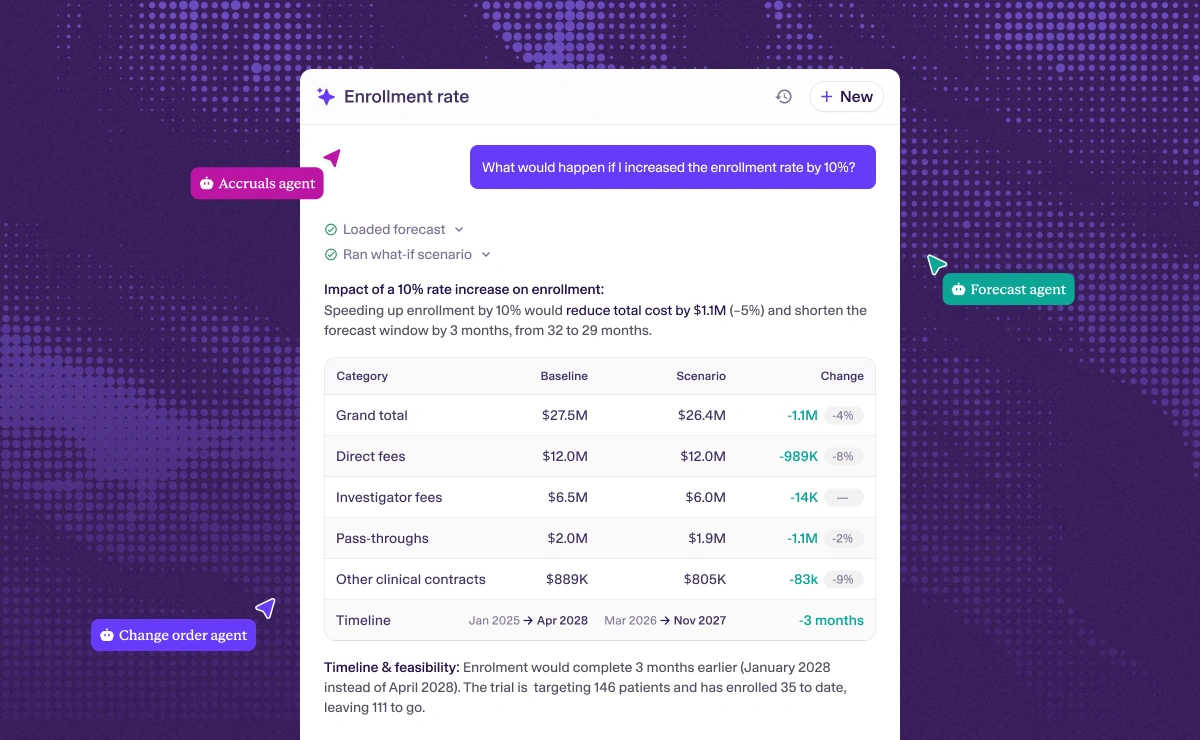

Today we unveiled Condor's Clinical Finance AI Agent — the world's first AI agent purpose-built for biopharma R&D finance.
Ask it why a trial's actuals and forecast diverged, and it reasons across your full budget and forecast history to give you the answer in seconds, not the days it takes to reconcile across your ERP, CTMS, EDC, and a dozen spreadsheets. Ask it what a change in site mix or enrollment timing will cost you, and it runs the scenario and builds the resulting model directly in Condor. It doesn't just surface a number. It gives you the "why," and then it does the work.
This is a big milestone for our company and industry. It's also the moment I've been building toward since the day I started Condor.
The vision I had five years ago
When I founded Condor, I believed the financial machinery underneath every clinical trial could be fully automated, end-to-end, with AI reasoning on top of it.
No more manually managing or outsourcing your finances. The numbers, built by an engine you can trust. Workflows run by AI. The why behind the numbers, uncovered in seconds instead of weeks, while there’s still time to act.
Our new agent is the realization of that vision.
Why it took five years
Building AI that produces numbers you can actually trust is unbelievably hard.
It took building Condor's financial engine first — a deterministic layer that follows defined rules, produces consistent output every time, and is fully auditable. No guessing, no black box, no "the model thinks it's probably right." Every number has to tie back to the clinical activity that actually drove it, because in this industry, a number nobody can defend is a number nobody will use.
It took building a knowledge graph grounded in a clinical and financial ontology we developed over years of work with Big 4 accounting firms — mapping how budgets, vendor contracts, clinical sites, and clinical activity actually connect to each other, across hundreds of studies and therapeutic areas. That ontology is what lets our agents understand a change order or a forecast variance the way a clinical finance team does, instead of the way a generic model guesses.
We built all of that first, five years ago, before there was a market pulling us to do it, because we knew it was the only foundation AI could stand on and still be trusted with a number that ends up in a board deck.
Recently, competitors that built their entire business model around outsourcing clinical finance — putting bodies behind the work instead of automating it — have realized AI is where our industry is headed. They're years behind, so the best they can offer is AI bolted on top of their services model.
Layering AI onto a services model doesn't change what the AI is standing on. If the underlying data was never built for automation — if it was always meant to be assembled by a person — AI on top of it can move faster, but it can't reason with the same grounding as our AI platform. It will take those companies years to build what we have been building for the last five years, because an ontology and a knowledge graph like ours can't be retrofitted. They have to be the starting point.
Why our AI platform matters now, more than ever
For most of the last century, science was the bottleneck in drug development. AI is closing that gap fast, and pipelines are about to fill with more candidates than this industry has ever had to fund at once. Every one of those candidates still has to be forecasted, funded, and managed. Right now, the financial infrastructure doing that job is still, for almost everyone, a spreadsheet.
The bottleneck didn't disappear. It moved from the lab to the ledger. Today, Condor is the only platform built from the ground up to run biopharma R&D finance and operations at the scale AI-driven pipelines are about to demand. Because we built the engine, then the knowledge graph, then the agents, in that order, on purpose.
What comes next
Our Clinical Finance Agent is one of a growing team of agents built on Condor's knowledge graph. Each one, including our forthcoming investigator grant agent, is purpose-built to remove a specific piece of manual work slowing R&D finance and clinical operations teams down.
My vision is here: No more manually managing your finances. The numbers built by our engine. The workflows run by AI. The why behind the numbers uncovered in seconds, not weeks, while there’s still time to act.
This is the start of something big for our industry.
If you want to see the agent for yourself, book a demo.
Recent posts

Stop Straight-Lining, Start Scaling: The Key to Faster, More Accurate Accruals

Clinical trials are among the most complex financial endeavors in biotech, requiring careful financial planning, tracking, and reconciliation. Ensuring accurate financial reporting and vendor accountability means answering three key questions: What do we expect to happen? What has actually happened? And what is driving the variance between expectations and reality?
The Challenge of Forecasting Clinical Trial Costs
Unlike other industries where cost forecasting follows predictable patterns, clinical trials introduce many unpredictable variables. Enrollment rates, protocol amendments, and site-specific costs can make standard financial tools ineffective. Forecasting must be dynamic, aligning cost distributions with actual clinical drivers rather than relying on broad assumptions.
Accrual accounting—determining costs incurred but not yet paid—is another essential component. Many companies still rely on spreadsheets to manage this process, but doing so often leads to inefficiencies. When data is delayed or inaccurate, finance teams must choose between speed and accuracy, a trade-off that can complicate compliance and financial reporting.
The Pitfalls of Straight-Lining Costs
One common but problematic approach is straight-lining costs—spreading expenses evenly over time. While this method may seem simple and efficient, it often leads to major financial and compliance issues. Inaccurate accrual estimates can trigger audit misstatements, requiring time-consuming adjustments and increasing the risk of financial restatements.
A better alternative is to use activity-based accruals and multi-source triangulation—leveraging multiple data sources to validate costs. This approach provides a more accurate picture of clinical trial expenses and enhances financial reporting. While implementing an automated accrual system requires upfront effort, the long-term benefits include faster close times, improved audit readiness, and reduced financial risk.
Case Study: Ventyx’s Transition to Automated Accruals
Ventyx, a leading biopharmaceutical company, faced significant inefficiencies in their R&D accrual process. Heavy reliance on CRO reporting and manual processes led to long close cycles, frequent audit adjustments, and budgeting challenges. Managing multiple Phase 1 and Phase 2 trials further complicated financial forecasting.
By adopting an automated accrual platform, Ventyx reduced their monthly close process by 78%, completing it in under a week. The impact was significant:
- Efficiency: Faster and more reliable accrual processing.
- Accuracy: Fewer post-close adjustments and better compliance.
- Collaboration: Improved communication across finance, FP&A, and clinical operations.
- Vendor Management: Enhanced visibility and stronger contract negotiation capabilities.
- Audit Readiness: Strengthened SOX compliance and reduced audit-related inquiries.
As Roy Gonzales, Senior Vice President of Finance at Ventyx, stated:
"Previously, our close process spanned between 3 to 4 weeks and heavily relied on our CRO. Our new system enabled us to streamline our monthly close process, cutting it down to under a week."
Ventyx’s experience underscores a crucial point: organizations don’t have to choose between speed and accuracy. By leveraging automation, they can achieve both.
The Role of Automation in Clinical Trial Financial Management
As clinical trial portfolios grow, managing financial reporting manually becomes unsustainable. Automation bridges the gap between finance, accounting, and clinical operations by:
- Integrating vendor contracts, change orders, and out-of-scope costs in real time.
- Ensuring forecasts and actuals remain aligned.
- Providing structured data that enhances transparency and decision-making.
Organizations that invest in automation transition from reactive financial management to proactive strategic oversight. By removing inefficiencies and enhancing data accuracy, finance teams can support broader business objectives more effectively.
Final Thoughts
Clinical trial financial management requires a delicate balance between efficiency and accuracy. While straight-lining costs may seem like an easy solution, it often creates more problems in the long run. Investing in automation, adopting multi-source triangulation, and aligning finance with clinical operations can ensure long-term financial stability.
The takeaway is clear: accurate, fast, and compliant accruals are not mutually exclusive. By making the right investments, biotech companies can streamline operations and gain greater financial control.
Read the article

Clinical Trial Reconciliation Best Practices

Clinical trials often involve complex, high-value contracts that require reconciliation as the trial nears its conclusion. With varied payment structures and contract terms, it’s crucial to understand your obligations to ensure that the final reconciliation is transparent, accurate, and fair for both parties.
Know Your Contract
Understand the Payment Structure
- Unit-based: Vendor bills monthly for work completed.
- Time and Materials: Vendor bills monthly for hours worked and associated costs.
- Milestone-based: Vendor bills a percentage of the contract value upon reaching key milestones (e.g., Last Site Activated, Last Patient In, Database Lock).
Considerations for Early Trial Termination
Minimize Carrying Costs: Immediately stop unnecessary activities (like meetings) after trial cancellation to avoid additional billing.
Blended Line Items: Review blended line items that include multiple activities to ensure they match actual trial activities.
- Monthly management units that require varying levels of effort throughout the trial are impacted most by this
- Project Management
- Clinical Team Management
- Meeting/Teleconference line items
- Usually include varying attendees required throughout the trial timeline
- Other common line items impacted
- Regulatory submissions
- ICF related units
- Database Migrations
- Protocol Amendments
- Minor vs. Major
Milestone Contracts: If milestones were not met, ensure vendors report actual work completed, not just based on invoices.
Additional Considerations
- Upfront Retainers: Track retainer balances in invoices and understand when they are drawn down and replenished. See the “Managing Upfront Payments” resource for details.
- Bonus/Penalty Clauses: Be clear about any contract clauses that could affect final costs or result in credits.
- Inflation Clauses: Clarify how inflation adjustments are calculated, especially if the trial timeline shifts.
Reconciliation Overview
The reconciliation process is the same across payment structures:
Total Cost Incurred −Total Amount Paid = Final Reconciliation Value
- Total Cost Incurred: The final contract value determined by the vendor and agreed upon by the sponsor.
- Total Amount Paid: All payments made to the vendor to date.
Documents to Request for Reconciliation
To confirm Total Costs Incurred, request:
- Final Budget with a detailed line item breakdown.
- Unit Tracker showing completed tasks by month.
- Record of all pass-through transactions and site payments made by the vendor.
- Site Listings: Includes recruitment, activation, and deactivation dates to validate site-related budget items.
- Final EDC Reports:
- Subject Visits Summary: Confirms patient visits by site.
- Invoiceable Reports: Verifies invoiceable activities.
- Final Visit Report: Tracks patient activity and final visits, useful in early trial shutdowns.
- Monitoring Visit Listings: Compares completed visits to the budget.
- Independent Expense Estimates: Use real trial data to assess the reasonableness of the final contract value.
To confirm Total Invoices Paid, request:
- Vendor-provided invoicing summary of all invoices sent and received payments.
- Internal invoicing summary of all payments made to the vendor.
Software Tools
- Clinical Trial Finance and Accounting Software: Newly adopted technologies that utilize real clinical trial data in tandem with all of the vendor contracts to produce a defensible estimate of trial spend in relation to the contracted terms. This provides a reasonability check against the final contract value the vendor is requiring.
- Investigator Grants Payment Software: Provide more clarity into what is being invoiced from each site and enable a more streamlined payment process.
- Automated Invoicing Software: Some ERPs are equipped to support automated invoicing with your vendor to provide transparency and alignment of all transactions, enabling a clear understanding across parties of the invoicing position per contract.
Benefits to Software Tools
- Automated workflows enable swift decision making and ease of scaling
- Utilize defensible clinical trial data to support calculations
Final Reconciliation Documentation
Once the final contract value and payments are agreed upon, memorialize the agreement in a final change order or closeout letter.
- A Final Change Order strikes the old contract and replaces it with the final budget.
- A Closeout Letter documents the final contract value rendered by the vendor.
Read the article